
Dairy Cow Welfare: How Flooring Influences Movement and Grip
Dairy cow welfare is shaped by many connected factors, from nutrition and hoof trimming to housing, hygiene and day-to-day herd management. Flooring is only one part of that picture, but it is a part every cow interacts with whenever she stands, feeds, moves through the building or travels to be milked.
A floor may remain structurally sound while becoming less suitable for the way cattle use it. Wear, slurry, moisture, poor drainage and changes between surfaces can all affect the confidence with which cows move. These issues are particularly important in busy areas where animals turn, accelerate, slow down or compete for space.
Looking at flooring through a welfare lens does not mean choosing the softest surface available or replacing every floor in the building. It means understanding what each area demands and whether the floor continues to provide an appropriate balance of grip, hoof interaction, cleanliness and durability.
Why confident movement matters
Cattle need to move around the building to reach feed, water, cubicles and milking facilities. In robotic systems, they may make these journeys voluntarily throughout the day. In conventional systems, groups may move together through collecting areas, parlour entrances and exit routes.
When footing feels secure, cattle are better able to walk at their own pace and negotiate the building naturally. When a surface becomes slippery or inconsistent, cows may shorten their stride, hesitate, lower their heads or avoid parts of the route.
A visible fall is an obvious warning sign, but it should not be the only trigger for investigating a floor. More subtle changes in movement can indicate that cows no longer have full confidence in the surface. AHDB guidance notes that non-slip flooring is important because cattle can become agitated after slipping and may remain fearful of it happening again.
Hesitation can have significant effects on the wider herd. One cow slowing at a gateway or turn can cause others to bunch behind her. Pressure builds, animals have less room to place their feet, and staff may need to intervene to keep the group moving. What appears to be a handling or cow-flow problem can therefore have a flooring component.
Grip must be a real consideration in modern cattle housing
Grip is sometimes treated as a choice between a smooth floor and a rough one. In practice, effective livestock flooring requires more nuance.
A floor needs sufficient traction to support confident movement, including when it is wet or contaminated. However, an excessively abrasive or uneven surface may place unnecessary demands on hooves. The objective is not to create a rough finish but to provide suitable and consistent footing for the area.
Grip can be influenced by:
- The original texture and pattern of the surface.
- Wear caused by cattle and machinery.
- Slurry, water and other contamination.
- Drainage and cleaning effectiveness.
- The direction in which cattle travel across grooves or openings.
- Transitions between different flooring materials.
- Damage, polished patches or uneven repairs.
The floor should therefore be assessed in use, not only when it is dry and freshly cleaned. A surface that appears adequate during a quiet inspection may behave differently during milking, after scraping or when several animals are moving through the same area.
Government welfare guidance says that floors, races and handling areas should be kept in good condition and free from sharp edges or projections that could injure cattle. AHDB also recommends sufficient grip in dairy housing to reduce the risk of slipping and injury.
The connection between flooring and hoof health
Lameness is a complex problem. Flooring should not be presented as either its sole cause or a complete solution.
Nutrition, infectious disease, hoof trimming, housing design, cow tracks, standing time and cubicle comfort may all contribute to mobility problems. AHDB identifies poor-quality housing floors and prolonged standing on hard surfaces among the general factors associated with lameness, alongside several other management and health influences.
Flooring can affect hoof health in several ways
A hard surface creates repeated hoof contact whenever the cow stands or walks. A highly abrasive surface may contribute to excessive wear, while a polished or contaminated floor may not provide enough grip. Persistent moisture and poor cleanliness can also create unfavourable conditions around the hoof.
The interaction is therefore more important than any single flooring characteristic. Farmers need to consider hardness, texture, drainage, cleaning and the amount of time cattle spend using the area.
Observation should be combined with routine mobility scoring, hoof records and input from the farm’s vet or hoof trimmer. This helps distinguish a localised flooring concern from a wider herd-health or management issue.
Where flooring pressure is greatest
Not every part of a dairy building presents the same challenge. Some areas carry more cattle, create sharper turns or remain wetter than others.
Parlour entrances and exits
Cows may be moving in groups, changing pace or negotiating changes in direction. Exit points are particularly demanding because cattle are leaving a confined space and may encounter a different surface immediately outside.
Collecting areas
High stocking pressure and frequent movement place substantial demands on the floor. Cows may need to turn or reposition while surrounded by other animals, leaving less room to recover from a loss of footing.
Robot approaches
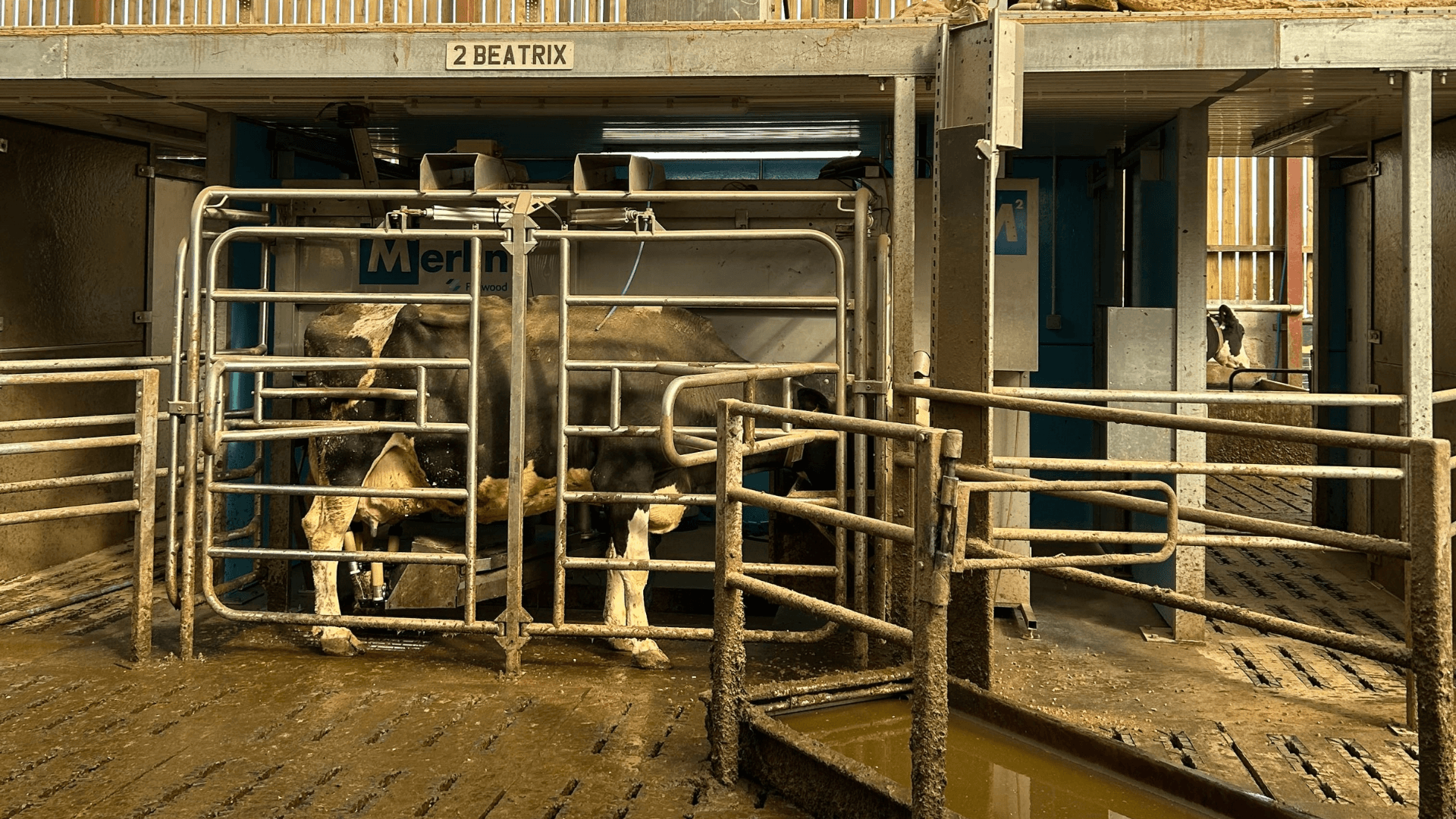
A robotic system depends on cows being willing and able to move through the building. Hesitation near the robot, selection gates or connecting passages may interfere with cow flow, although flooring should be considered alongside layout, social pressure and equipment design.
Crossings and turning points
Changes of direction increase the need for secure lateral grip, something that concrete can not always guarantee. Right-angled corners usually interrupt movement, which is why official cattle-welfare guidance recommends gently curved races where possible.
Cubicle and feed passages
Cows may spend long periods standing and walking in these areas. Flooring must work alongside scraping, slurry removal and machinery use without becoming unsuitable for cattle.
These differences support a zoned approach to flooring. Rather than assuming one surface should be used throughout the building, the farm can consider what each route or area needs to achieve.
Moisture, slurry and cleaning cannot be separated from grip
A flooring product does not perform independently of the way it is cleaned and maintained.
Slurry and moisture can reduce traction, conceal wear and affect hoof conditions. Poorly drained areas may remain wet even when the wider passage appears clean. At the same time, the floor needs to remain compatible with the farm’s scraper or cleaning system.
Drainage openings, surface patterns and scraping direction need to work together. AHDB describes effective drainage and grooved flooring as ways to support cleaner surfaces and provide traction for cattle.
Cleaning should also be considered when different materials meet. Raised edges, damaged coverings or inconsistent surface heights may collect waste and create awkward foot placement. Any flooring improvement therefore needs to be assessed as part of the complete system rather than as a surface treatment alone.
Signs that a floor deserves closer attention
Farmers and herd managers see the cows and the building every day, but gradual deterioration can be easy to overlook. Useful warning signs include:
- Repeated slipping or stumbling in one location.
- Cows slowing or stopping at a particular transition.
- Shortened steps or unusually cautious movement.
- Bunching at entrances, exits or corners.
- Smooth, polished or visibly worn patches.
- Standing water or persistent slurry contamination.
- Cracked sections, sharp edges or uneven repairs.
- Mats or coverings that have moved, lifted or deteriorated.
- Increased mobility concerns without an obvious single cause.
These observations do not automatically mean that the whole floor needs replacing. The first step is to establish whether the problem is localised, whether cleaning or drainage is contributing, and how the area is used at its busiest.
Choosing flooring around the way the building works
A welfare-led flooring decision must also be operationally realistic.
The farm needs to consider livestock movement, scraper compatibility, slurry handling, machinery loading, maintenance and installation. A surface that provides grip but prevents effective cleaning is unlikely to remain suitable. Equally, a durable floor that cattle are reluctant to cross is not meeting the full needs of the building.
AgriStride hybrid flooring combines precast concrete with integrated rubber elements. The range is intended for different livestock-flooring applications rather than treating every part of the shed as the same environment. Current products include Classic, Vario and Moov, with Moov designed specifically for cattle race channels and movement routes around parlours, robots and collecting yards.
The appropriate solution will depend on the building, the existing structure and the way the farm operates. In some cases, a targeted improvement in a high-pressure zone may be more practical than replacing every passage. In others, a new-build project provides an opportunity to plan different flooring zones from the outset.
The important question is not simply, “Is this floor non-slip?” It is: does this floor provide suitable and consistent footing for the cattle, cleaning system and daily demands of this particular area?
Flooring as part of a wider welfare plan
Good dairy cow welfare cannot be delivered by one product or one building feature. Flooring works alongside hoof care, hygiene, nutrition, handling, housing layout and regular observation.
Its role should nevertheless be taken seriously. Cows use the floor throughout the day, and small signs of hesitation or reduced grip can reveal problems before structural failure occurs.
By reviewing how cows move, identifying pressure points and considering each part of the building separately, farmers can make flooring decisions that support both welfare and practical farm operation.
Frequently asked questions
1. How can I tell whether dairy cows have enough grip?
Repeated slipping, shortened steps, hesitation, head lowering or bunching at one location may suggest that footing requires investigation. Inspect the area when wet or contaminated as well as when clean to find the cause of the issues.
2. Can poor flooring cause lameness?
Poor-quality floors may contribute to lameness, but lameness usually has several interacting causes. Hoof trimming, hygiene, nutrition, disease, cubicle design, standing time and cow tracks should also be reviewed. Seek advice from the farm’s vet or hoof-care professional where mobility concerns arise.
3. Should the same flooring be used throughout a dairy building?
Not necessarily. Parlour routes, collecting areas, robot approaches, cubicle passages and machinery routes can place different demands on a floor. A zoned approach allows grip, cleaning, drainage and structural requirements to be considered for each application.
4. Is rubber flooring always better for cow welfare?
Rubber can offer useful grip and cushioning, but material alone does not determine suitability. Fit, drainage, cleaning, durability, movement and the condition of the underlying structure all matter. The correct solution depends on how the area is used.
5. Do I need to replace the whole floor if cows are slipping?
Not always. First identify where and when the problem occurs and assess wear, drainage, cleaning and surface transitions. A targeted improvement may be appropriate in a particular high-pressure area, although the wider flooring system should still be inspected.